The most promising automation may be the task someone repeats every afternoon. Look for work that follows a recognisable pattern and has an outcome your team can verify. Use ordinary rules where they are sufficient; add AI when interpreting or drafting information is useful.
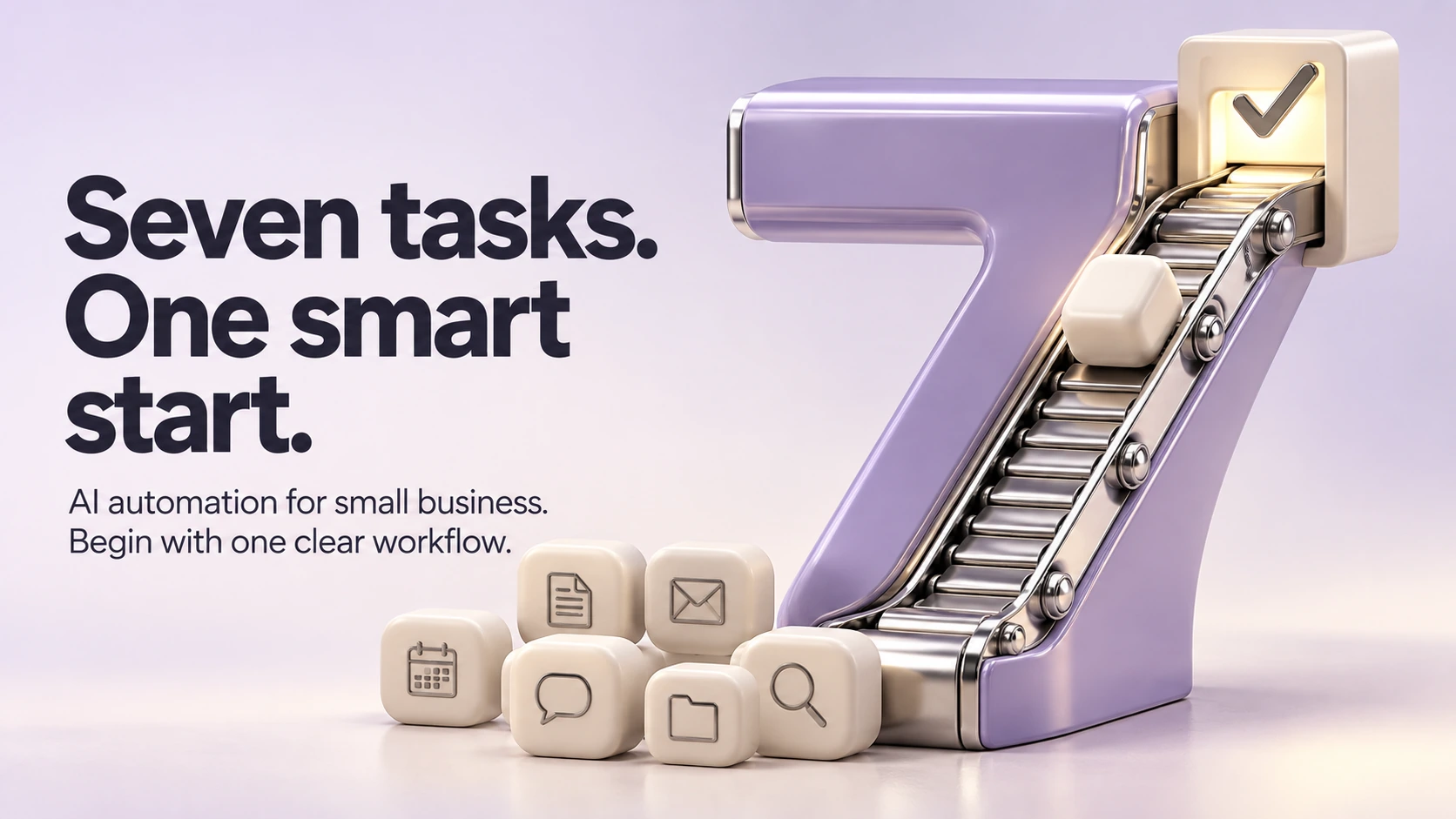
Seven starting points worth examining.
- Enquiry summaries. Turn a long message into a short internal brief, preserving the original for review.
- First-draft replies. Suggest an answer from approved information, with a person reviewing it before it is sent.
- Meeting notes. Organise an authorised transcript into decisions, open questions, and proposed next steps.
- Content preparation. Produce a structured draft from an approved brief and reference set.
- Internal routing. Suggest which person or queue should receive a request.
- Knowledge-base organisation. Group repeated questions and flag gaps in the existing answers.
- Routine report narratives. Draft a plain-language explanation from verified metrics without inventing causes or results.
Choose one workflow you can observe.
Document how the task works today. Identify the trigger, input, output, owner, and exception path. If those parts are unclear, automate later. A confusing manual process usually remains confusing when software runs it faster.
| Question | What a useful answer looks like |
|---|---|
| What starts the task? | A specific form submission, event, or reviewed input. |
| What may the system change? | A small, explicit set of permitted actions. |
| Who checks the result? | A named role with access to the original input. |
| What happens on failure? | A visible queue, a useful error, and a recovery path. |
Put approval where consequences begin.
Generating a draft and sending it to a customer are different steps. Preserve that distinction for content publishing, bookings, sensitive conversations, and anything with a financial consequence. Review should be built into the workflow rather than added after an error.
Automate a repeatable task. Keep responsibility visible.
ZXP editorial perspective
Count the overhead too.
Measure setup time, review time, corrections, and maintenance as well as the time the task previously took. A workflow is useful when the total experience improves for the team and the customer, not simply because an automatic step exists.
Read about AI receptionists for a detailed example, or explore AI automation with ZXP.
A perspective from the ZXP team.
Designed to help you ask better questions and take a clearer next step.