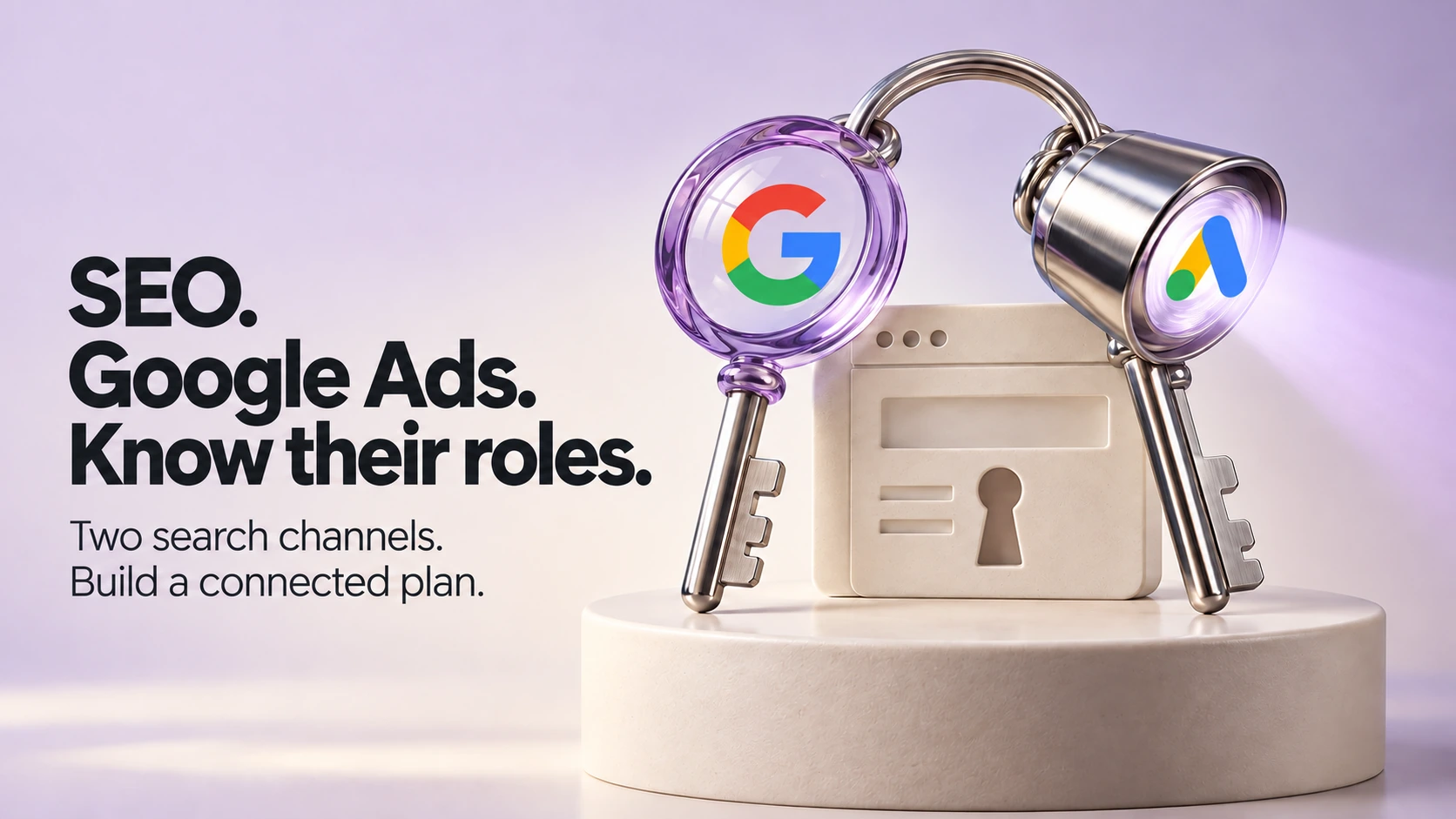
When a customer searches for your service, your business may appear through an advertisement or an unpaid search result. Both can lead to the same website, but the work behind them is different.
Two channels, different mechanisms.
Google distinguishes paid advertising from organic search placement. Buying an advertisement does not buy a better position in the organic results. 1
SEO involves making your website understandable, useful, and accessible to search engines and visitors. Search advertising involves creating campaigns that are eligible to compete for ad placements. Neither approach turns a weak offer or a confusing page into a useful customer experience.
| Consideration | SEO | Google Ads |
|---|---|---|
| Main work | Useful content, technical foundations, and relevance. | Campaign structure, targeting, creative, bids, and landing pages. |
| Spend | Ongoing investment in the site and its content. | Media spend plus campaign management and creative work. |
| Control | You influence the site; the search engine determines visibility. | Campaign settings influence eligibility and delivery. |
| Evaluation | Search visibility and useful organic enquiries. | Paid traffic quality, useful enquiries, and acquisition cost. |
Choose a job for each channel.
A business introducing a new service may want to test a focused campaign while developing a useful set of service pages. Another may need to fix the site’s structure before adding more traffic. The sequence should follow the business problem.
- Define the service and geography you want to focus on.
- Check whether the landing page answers a prospective customer’s questions.
- Define a useful enquiry and how it will be recorded.
- Set a review period and a spending boundary before testing.
Measure the quality of the opportunity.
Clicks are a starting point. Ask what happened next: did someone call, complete a relevant form, book, or become a customer? Keep the definition of a useful enquiry consistent so the team can compare channels without changing the rules halfway through.
Make the channels connect.
Questions you hear in sales conversations can inform service-page content. Search terms can suggest a clearer way to describe your offer. Keep that learning shared instead of treating paid and organic work as separate worlds.
Explore SEO and Google Ads, then decide which problem you want to solve first.
Sources & references
- 01Ads on Search
Google
A perspective from the ZXP team.
Designed to help you ask better questions and take a clearer next step.